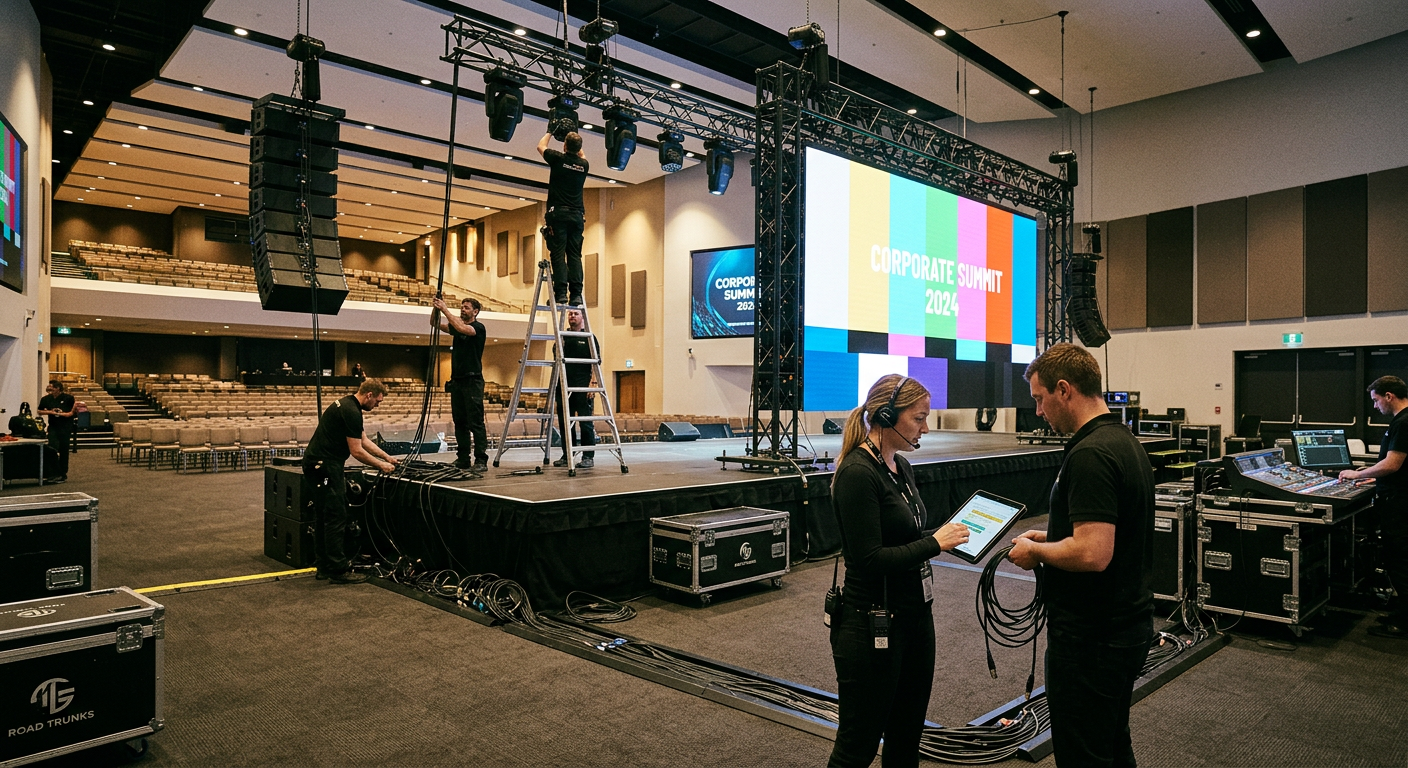
Direct answer
A credible event production company should be able to walk you through signal path, power, rigging, redundancy, staffing ratios, and a load-in/strike timeline before it quotes a price. Compare proposals on scope and contingency planning, not just the headline number—missing labor, overtime, freight, and backup equipment are the most common sources of surprise costs.
What "event production" actually covers
"Event production company," "AV production company," and "technical production" are often used interchangeably, but the scope behind them varies widely. Some vendors own their audio, video, and lighting equipment and crew every show in-house. Others broker rental gear and subcontract labor per event. Neither model is automatically better, but you should know which one you are hiring before you compare prices.
Ask directly: what equipment do you own versus rent for this event, who are the on-site technicians, and are they employees or subcontracted crew? A vendor that cannot answer clearly is harder to hold accountable if something fails on event day.
The technical checklist to request before you book
A serious production vendor should proactively cover power, rigging, internet, and redundancy in its proposal—not wait for you to ask. Venue constraints like load-in access, ceiling height, available power circuits, and house AV ownership all change the real cost and feasibility of a design.
- Signal path: how audio, video, and lighting systems connect, and who owns each handoff with the venue.
- Power and internet: confirmed circuits, dedicated internet lines, and who is responsible if the venue cannot deliver what was promised.
- Redundancy: backup microphones, playback devices, recording systems, and a plan if primary equipment fails mid-event.
- Rigging and safety: who is certified to rig trussing or motors, and what the venue requires for insurance and inspection.
- Staffing ratios: how many technicians are on site per system (audio, video, lighting, stage management) and for how long.
- Rehearsal and show-file freeze: when content, decks, and cues are locked before the event so last-minute changes do not introduce risk.
How to compare AV and production quotes fairly
Line-item quotes are easier to compare than bundled day rates. Ask each vendor to separate equipment rental, labor, travel, freight, rigging, power distribution, permits, insurance, and contingency. A lower headline number can become the most expensive option once missing labor hours or overtime are added back in.
Confirm the load-in and strike windows in writing, since overtime is one of the most common unplanned costs in technical production. Ask what happens if the event runs long, the venue changes access hours, or additional power or cabling is required on site.
- Request an itemized breakdown: equipment, labor, travel, freight, rigging, power, permits, insurance, and contingency.
- Confirm standard versus overtime labor rates and the trigger for each.
- Ask what is explicitly excluded, such as venue house fees, additional power drops, or weather contingencies for outdoor events.
- Get the cancellation and rescheduling policy in writing before paying a deposit.
Final review before load-in
In the final days before an event, a competent production team runs a technical review: verifying signal path, confirming microphone and camera positions, testing the internet path, and checking backup systems. If your vendor has not proposed a pre-event technical check, ask for one—especially for hybrid, livestreamed, or multi-camera events where a single point of failure can affect the entire program.
Picnyk is a marketplace for discovering and comparing event vendors, including production and AV partners. Picnyk does not provide production services directly; the production company you hire remains responsible for its technical plan, staffing, equipment, and on-site execution.
Frequently asked questions
What is the difference between an AV company and an event production company?
An AV company typically focuses on audio, video, and lighting equipment and technicians. An event production company may also manage staging, set design, show-calling, scenic elements, and overall technical direction. Many vendors do both—ask for the specific scope in writing rather than relying on the title.
What questions reveal whether a production vendor is a good fit?
Ask about owned versus rented equipment, crew certification for rigging, redundancy plans for critical systems, staffing ratios, standard versus overtime labor rates, and what happens if the venue changes access or power availability.
Why do event production quotes vary so much for a similar event?
Quotes vary based on owned versus rented equipment, crew experience and certification, redundancy and backup equipment, load-in/strike windows, and whether labor, freight, rigging, permits, and contingency are itemized or bundled into a single day rate.
Does Picnyk provide AV or event production services directly?
No. Picnyk is a marketplace and planning platform that helps you discover and compare event production, AV, staging, and technical vendors. The vendor you hire is responsible for its own equipment, staffing, and on-site execution.