Direct answer
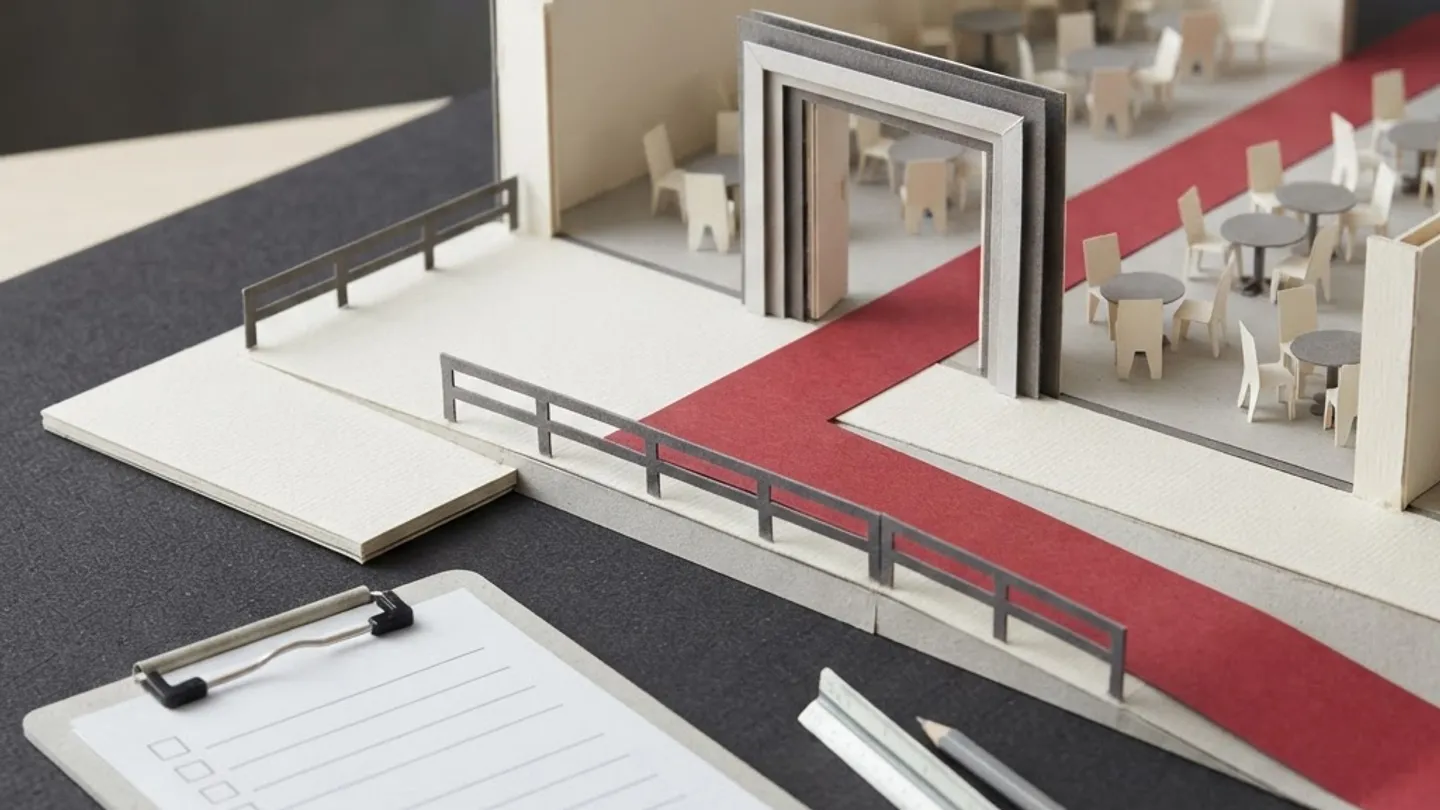
Before booking, verify the full guest journey: arrival, entrance, circulation, seating, restrooms, communication, and participation in the program. Ask the venue for evidence tied to your actual layout and a named contact for unresolved barriers. Accessible transit nearby does not verify the last part of the route, and a host’s checklist is not an ADA certification.
What changes this decision?
Complete arrival-to-seat route
Participation and communication
Evidence, ownership, and backup
Does nearby BART or Muni establish venue accessibility?
No. BART describes accessible station features including elevators, wider fare gates, and level boarding. SFMTA provides accessible-transportation guidance and a pathway to Muni Metro elevator status. Those are useful trip-planning resources, not assessments of a venue entrance or the sidewalk between the station and the event.
Trace the final segment with the venue: station exit, crossing, surface changes, entrance, and any alternate door. Ask which arrival point staff will actually open during event hours. Check current service and elevator information close to the event and communicate a verified alternative if a necessary route is unavailable. A transport brochure does not guarantee a particular elevator will be operating that day.
Source: BART: accessibility overviewSource: SFMTA: accessible transportation resourcesWhat should the physical walkthrough include?
Follow a guest’s route in the proposed event setup, not only in an empty room: check-in, coat storage, seating, dining, restrooms, presentation areas, and exits. Ask for current photos, layout documents, relevant measurements from the venue, and a contact who can resolve uncertainty. Do not infer compliance from a wide-angle photograph or an “accessible” tag.
Look for temporary obstructions created by the event itself—registration queues, floral displays, cables, stacked chairs, or a buffet that narrows the only circulation route. Verify that the approved arrangement will be preserved after setup. This is an evidence-gathering walkthrough, not a dimensional standard, building assessment, or substitute for qualified accessibility advice.
Can guests participate as well as enter?
A guest who can enter but cannot hear the speaker, read the materials, reach the presentation area, or join the discussion has an unresolved participation barrier. Ask about microphone use, sightlines, captions, interpreters where appropriate, accessible documents, and how questions will be taken. Consider speakers and staff as well as seated attendees.
The U.S. Department of Justice explains that covered Title II and Title III entities must communicate effectively with people who have communication disabilities. The suitable aid or service depends on the communication’s nature, length, complexity, context, and the person’s normal method. Do not assume one format works for everyone or claim that this article determines every entity’s legal obligations.
Source: DOJ: effective communication requirementsHow should the host collect accommodation requests?
Provide a clear, usable contact channel early and ask what support would enable participation, without requesting a diagnosis. Tell the person who will respond and discuss the proposed arrangement with them rather than guessing. Restrict any necessary personal information to the people arranging the support.
DOJ’s guidance allows reasonable advance notice based on what is needed to arrange aids and services, but warns against excessive notice requirements and says walk-in requests must be honored to the extent possible. A planning deadline should help preparation, not become an automatic refusal rule. Budget and responsibility should be discussed with the relevant covered entity and providers.
Source: DOJ: effective communication requirementsWhat evidence belongs in the booking decision?
Record each feature separately as documented, unresolved, or requiring a change. Attach the floor plan version, venue response, responsible contact, and date. Avoid collapsing the record into a “passed ADA” score. If a critical route relies on an elevator, ask who monitors it, what a failure response involves, and whether the proposed alternative actually works.
Repeat the route check after vendors finish setting up, then brief front-of-house staff on the agreed arrangements and escalation contact. For emergency planning, obtain the venue’s procedure and qualified guidance rather than improvising lifting or evacuation instructions. If a barrier remains unresolved, choose another layout or venue instead of leaving a guest to solve it on arrival.
Reusable planning worksheet
Arrival-to-participation evidence worksheet
For each row, record the evidence, owner, deadline, and unresolved issue. This worksheet does not certify compliance or prescribe building dimensions.
- Transit and drop-off
- When: Before shortlist decision
- Exact station exit or drop-off point, final approach, current access resources, and alternate arrival option.
- Entrance and circulation
- When: During walkthrough
- Actual event entrance, route surfaces and changes, doors, and the proposed furnished floor plan.
- Seating and dining
- When: Before layout approval
- Seating choices, companion seating, access to meal service, and circulation during service.
- Restrooms
- When: Before contract
- Location, route, current venue documentation, availability during event hours, and unresolved barriers.
- Program participation
- When: Before production order
- Speaker access, sightlines, microphones, requested communication supports, and accessible materials.
- Request channel
- When: With invitations
- Contact method, response owner, privacy handling, and a process for later requests.
- Final setup and outages
- When: Before guests arrive
- Route check, staff briefing, equipment or elevator escalation, and venue emergency-planning contact.
| Decision | When to resolve | Evidence to record |
|---|---|---|
| Transit and drop-off | Before shortlist decision | Exact station exit or drop-off point, final approach, current access resources, and alternate arrival option. |
| Entrance and circulation | During walkthrough | Actual event entrance, route surfaces and changes, doors, and the proposed furnished floor plan. |
| Seating and dining | Before layout approval | Seating choices, companion seating, access to meal service, and circulation during service. |
| Restrooms | Before contract | Location, route, current venue documentation, availability during event hours, and unresolved barriers. |
| Program participation | Before production order | Speaker access, sightlines, microphones, requested communication supports, and accessible materials. |
| Request channel | With invitations | Contact method, response owner, privacy handling, and a process for later requests. |
| Final setup and outages | Before guests arrive | Route check, staff briefing, equipment or elevator escalation, and venue emergency-planning contact. |
Copy this venue walkthrough request
Event format, date, and layout: [details] Arrival options: [transit / drop-off / parking] Please walk through the route to the entrance, check-in, seating, dining, restrooms, presentation area, and exit. For each point record: [evidence / unresolved barrier / responsible contact / action deadline]. Communication and participation needs to discuss: [requested supports; no diagnoses needed] Elevator or route outage alternative: [confirmed arrangement] Final setup check owner: [name / time] Please distinguish documented features from claims that still need specialist assessment.
Replace bracketed fields with your event details. Nothing is submitted or saved here.
Questions to ask before committing
- 01Can we verify the entire route in the actual event layout?
- 02Who resolves each documented barrier before the booking becomes binding?
- 03How can attendees and speakers request support without disclosing diagnoses?
- 04Who checks the final setup and responds if the agreed route becomes unavailable?
Frequently asked questions
Does “near BART” mean the venue is accessible?
No. Verify the station exit, route to the venue, entrance, internal circulation, restrooms, and program setup separately. Check current transit access information near the event date.
Does this worksheet certify a venue as ADA compliant?
No. It records evidence and unresolved questions for a booking decision. Compliance assessment and legal obligations require appropriate expertise and context.
Should hosts ask guests for medical diagnoses?
For event planning, ask what support would enable participation rather than asking for a diagnosis. Discuss the arrangement with the attendee and limit sharing to those coordinating it.
Methodology, sources, and next research
Source review: September 9, 2026. BART and SFMTA establish transportation resources; DOJ establishes effective-communication guidance for covered entities. The walkthrough and evidence statuses are Picnyk planning recommendations, not observations from an inspected property or a technical compliance standard.
Sources
Bay Area Rapid Transit · BART network. Supports: Station elevators, accessible fare gates, level boarding, communication features, and access resources. Accessed .
San Francisco Municipal Transportation Agency · San Francisco transportation services. Supports: Muni accessibility, elevator-status resources, ramp taxis, and paratransit information. Accessed .
U.S. Department of Justice · Covered Title II and Title III entities in the United States. Supports: Effective communication, auxiliary aids and services, consultation, and accommodation-request considerations. Accessed .