Direct answer
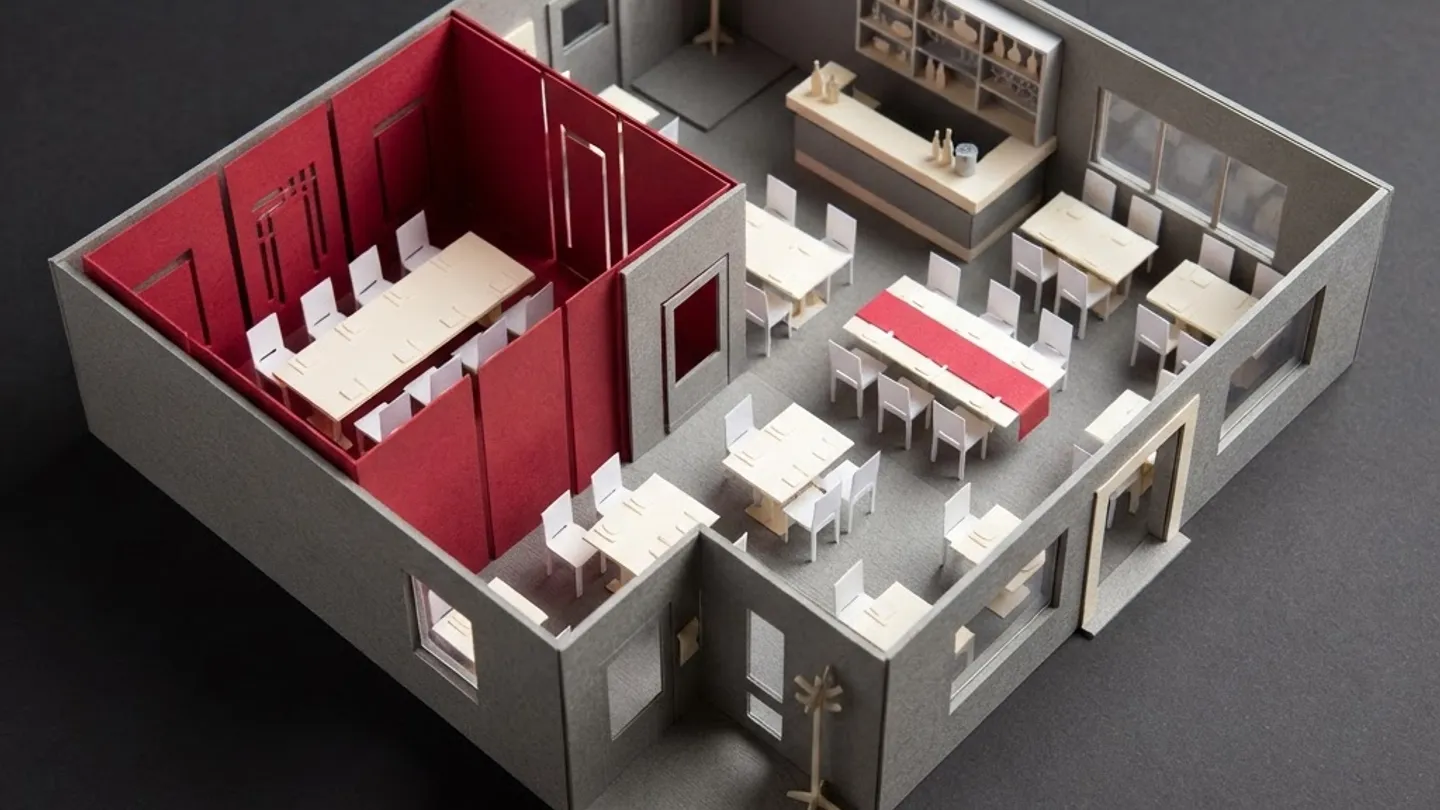
Choose a private dining room when your group and program fit the room and you do not need exclusive use of the restaurant. Consider a buyout when privacy, guest flow, or control of multiple spaces matters enough to justify a wider contract. Compare the same seated or reception format, access hours, inclusions, and total obligation—not only a food-and-beverage minimum.
What changes this decision?
Privacy and guest circulation
Seated versus reception layout
Contract scope and complete cost
Is a private dining space actually private?
Ask whether the space has walls and doors, shares sound with the main restaurant, or requires other diners to pass through it. “Private dining” is a department name on many restaurant websites; it does not necessarily describe every space that department sells.
Foreign Cinema’s official page illustrates the distinction. It lists the Mezzanine as a semi-private setting for 30 seated guests and the Director’s Table for 12 seated guests as semi-private. It separately describes a whole-restaurant buyout closed to the general public. These are published configurations, not Picnyk inspections or a recommendation that any space is suitable for confidential discussion.
Source: Foreign Cinema: private dining spacesWhy must seated and reception capacities stay separate?
A reception capacity cannot be reused as the number of people who can sit down to dinner. Waterbar publishes the Bridge Tower Room as ideal for 60 seated guests or 75 reception-style guests, and its Full House Buyout as ideal for 180 seated or 350 reception-style guests. Foreign Cinema lists 166 seated guests for its entire restaurant.
Use these as examples of differently defined inventory—not numbers to combine across rooms or a confirmed capacity for your layout. A stage, presentation screen, buffet, dance area, accessible circulation, or registration table can change the proposed arrangement. Request the restaurant’s approved floor plan for your actual program before sending invitations.
Source: Waterbar: private dining and buyoutsSource: Foreign Cinema: private dining spacesDoes meeting the food-and-beverage minimum cover everything?
Do not assume so. Ask which menu and beverage purchases count toward the minimum, whether tax and service charges are excluded from that calculation, and whether there is a separate room fee. Ask how a shortfall is charged and whether adding a second space changes the minimum. We have not verified current dollar minimums for these restaurants and do not publish invented ones.
Compare the complete financial obligation for the same headcount and schedule: eligible food and drinks, separate room charges, staffing or extension fees, AV, tax, stated service charges, and any optional gratuity. Keep deposits and payment timing separate from incremental costs so the same obligation is not counted twice. A larger minimum can be reasonable for exclusivity, but it is not automatically better value.
When is a buyout worth investigating?
A buyout is worth discussing when guest circulation, a multi-part program, branding, or separation from public diners cannot be achieved within the available private room. Confirm exactly what is exclusive: dining room, bar, patio, entrance, restrooms, and operating hours may not all have the same boundaries.
For a straightforward team dinner, a suitable private room can reduce unused space and coordination. For a presentation, ask about ambient noise, microphone permissions, sightlines, daylight, screen placement, and setup time. Waterbar identifies its two private dining rooms as second-floor spaces; that is a reason to verify the full arrival and elevator route, not to infer either accessibility or inaccessibility from the floor number.
Source: Waterbar: private dining and buyoutsReusable planning worksheet
Private room versus buyout comparison worksheet
Fill a copy for each proposal using the same guest count and event hours. Leave a field unresolved until the restaurant confirms it.
- Exclusivity boundary
- When: At first inquiry
- Name each included space and whether public diners, staff, or other events share it.
- Capacity and layout
- When: Before guest commitment
- Separate seated and reception capacity; attach the agreed layout with presentation and circulation needs.
- Minimum and fees
- When: Before price comparison
- What qualifies toward the minimum, shortfall treatment, separate charges, tax basis, and gratuity policy.
- Menu and service
- When: Before deposit
- Dietary handling, beverages, service format, guaranteed count deadline, and meal timing.
- Program and access
- When: Before contract
- AV permission, sound/privacy limits, accessible arrival, restrooms, load-in, and staff access.
- Hold and cancellation
- When: Before signing
- Hold expiration, payment dates, cancellation obligation, and weather terms for any outdoor portion.
| Decision | When to resolve | Evidence to record |
|---|---|---|
| Exclusivity boundary | At first inquiry | Name each included space and whether public diners, staff, or other events share it. |
| Capacity and layout | Before guest commitment | Separate seated and reception capacity; attach the agreed layout with presentation and circulation needs. |
| Minimum and fees | Before price comparison | What qualifies toward the minimum, shortfall treatment, separate charges, tax basis, and gratuity policy. |
| Menu and service | Before deposit | Dietary handling, beverages, service format, guaranteed count deadline, and meal timing. |
| Program and access | Before contract | AV permission, sound/privacy limits, accessible arrival, restrooms, load-in, and staff access. |
| Hold and cancellation | Before signing | Hold expiration, payment dates, cancellation obligation, and weather terms for any outdoor portion. |
Copy this restaurant inquiry
Event date, guest count, and purpose: [details] Format: [seated dinner / reception / presentations] Privacy needed: [enclosed room / semi-private acceptable / full property] Arrival, program, and departure times: [times] Requested spaces and access needs: [rooms / accessible route / restrooms] Please quote the exact room or buyout boundary, final layout capacity, menu and beverage minimum, what counts toward it, separate fees and taxes, AV, service hours, cancellation terms, and hold expiration. Please mark all exclusions.
Replace bracketed fields with your event details. Nothing is submitted or saved here.
Questions to ask before committing
- 01Which exact spaces are exclusive, for which hours?
- 02Is the quoted capacity seated, standing, or approved for our actual layout?
- 03What counts toward the minimum, and what is charged separately?
- 04Can the full arrival, dining, restroom, and presentation route support our guests?
Frequently asked questions
Is a semi-private dining area suitable for a confidential company meeting?
Do not assume it is. Ask about acoustic separation, doors, sightlines, and public circulation. A space marketed for private dining may still be semi-private.
Can I use reception capacity for a seated dinner?
No. Compare the capacity for your actual format and approved layout. Reception figures can be higher because they describe a different use of the room.
Does this guide list current restaurant minimum spends?
No. Current dollar minimums have not been verified for the examples. Request a date-specific proposal and compare minimum eligibility, separate fees, taxes, and contract terms.
Methodology, sources, and next research
Source review: September 9, 2026. Capacity and privacy examples come from the restaurants’ own private-dining pages. We did not visit, measure, rate, or check availability at either property. The worksheet is an original Picnyk comparison framework, not a market-price study.
Sources
Foreign Cinema · Foreign Cinema, San Francisco. Supports: Published seated capacities, semi-private configurations, and whole-restaurant buyout description—not prices or availability. Accessed .
Waterbar · Waterbar, San Francisco. Supports: Separate seated and reception capacities, second-floor rooms, and full-house buyout configuration—not a quote. Accessed .